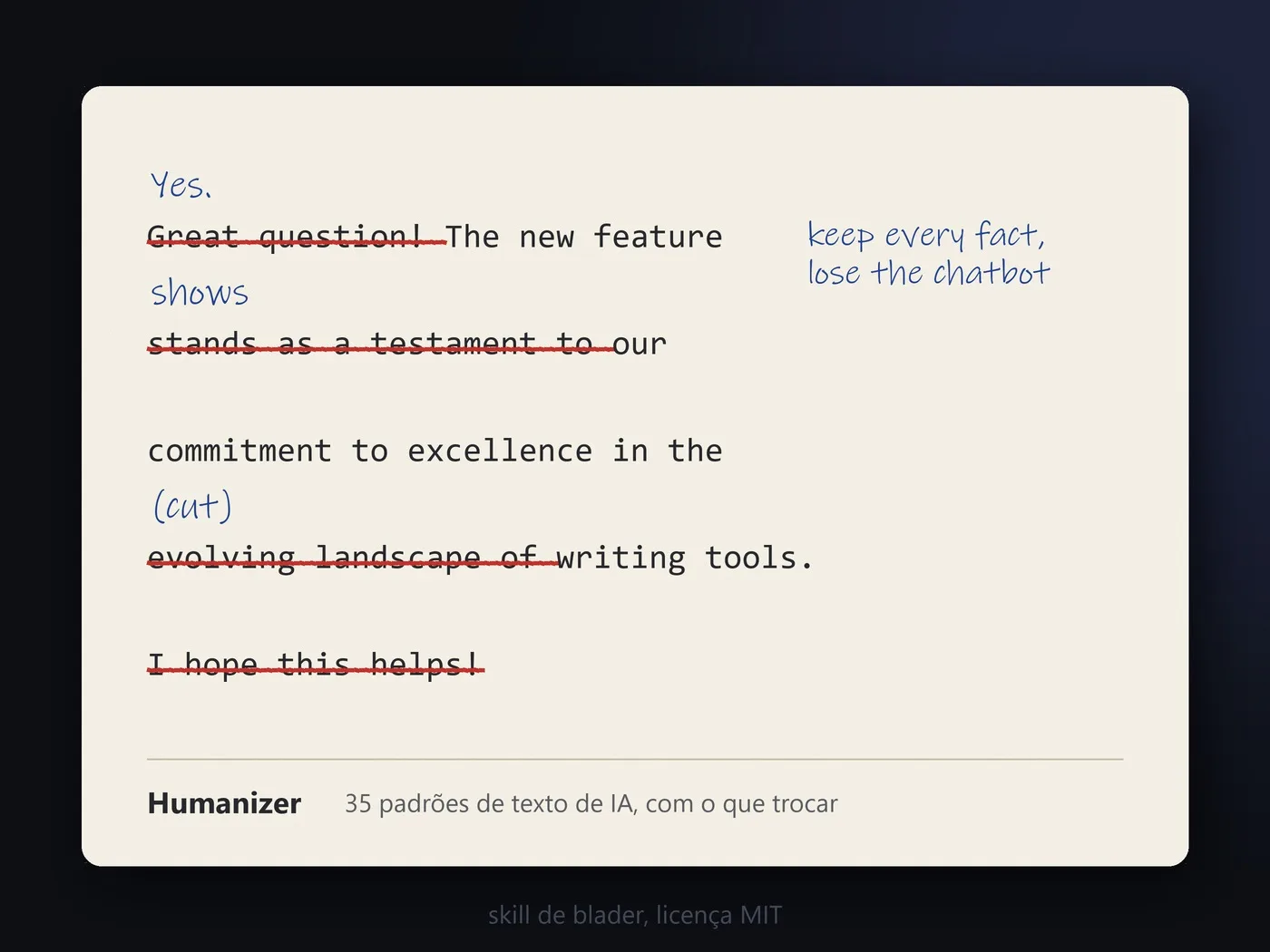
Descrição do autor
Skill de agente que reescreve texto com cara de IA para soar como a pessoa que escreveu, sem mudar o que o texto afirma e sem inventar detalhe. Vem do repositório blader/humanizer, que estava no GitHub Trending em 5 de setembro de 2026 e é distribuído sob licença MIT. Baseia-se na página "Signs of AI writing" da Wikipédia: 35 padrões em cinco grupos (conteúdo inflado, vocabulário de IA, estilo como excesso de negrito e travessão, restos de chatbot, enchimento e hedging), cada um com palavras a vigiar, mais uma lista de falsos positivos para não caçar fantasma e um processo de reescrita em quatro passos. Serve para quem edita post, e-mail, documentação ou copy gerada por IA e quer que passe por leitura humana. Como usar: salve como SKILL.md em ~/.claude/skills/humanizer/ (ou a pasta de skills da sua ferramenta) e peça "humanize este texto"; opcionalmente cole dois ou três parágrafos seus para a skill imitar sua voz. O que eu testei: rodei no Claude (Fable 5.1) sobre um parágrafo de marketing gerado por IA com saudação de chatbot, "nestled in the heart of", grupo de três forçado e fecho otimista genérico; a reescrita removeu os quatro padrões, manteve todos os fatos e saiu com metade do tamanho. O que mudei em relação ao original: esta é uma versão condensada para caber no limite de tamanho do CopyPrompt. Mantive os 35 padrões com as palavras a vigiar e a regra de cada um, mantive um exemplo antes e depois nos padrões 1 a 13 e removi os exemplos dos padrões 14 a 35, a subseção "Human details to keep" e o cabeçalho YAML. Também troquei os travessões do texto por vírgula ou pelo nome do caractere. O arquivo completo, com todos os exemplos, está no repositório.
O pacote
Instalar esta skill
npx copyprompt-cli add humanizer-remover-padroes-de-texto-de-ia-sem-mudar-o-que-o-texto-diz-skill-de-blO comando imprime o pacote inteiro e pergunta antes de escrever qualquer coisa. Nada é instalado até você ler e responder que sim.
Precisa de uma chave de API de conta com e-mail confirmado: rode `npx copyprompt-cli login` uma vez e cole uma chave de Configurações.
SKILL.mdHumanizer: remove AI writing patterns
Rewrite AI-sounding text so it reads like the writer, not a chatbot. Do not change what it says or make up details.
The patterns below come from Wikipedia's , maintained by WikiProject AI Cleanup.
What to do
When given text to humanize:
- Find AI patterns. Check the text against the patterns below.
- Keep every claim. You may shorten dull parts, expand useful parts, and merge or split paragraphs. Keep the information even when you change the structure.
- Do not invent facts. Do not add a fact, name, number, date, quote, or citation unless it comes from the source or the user. If a sentence needs a missing detail, ask for it or use a simpler sentence. You may add an opinion or reaction when the writer's voice calls for one, but you may not add a factual claim. Fiction is exempt because invented details are part of the task.
- Match the voice. Use the right tone for the text, such as formal, casual, or technical. Add personality only when the text and the writer call for it.
The input type controls what you return. See How to return the result. Use the same rewrite process in every mode.
Match the writer's voice
If the user provides a writing sample (their own previous writing), analyze it before rewriting:
- Read the sample first. Note its sentence length, word choice, paragraph openings, punctuation, repeated phrases, and transitions.
- Match those habits. Do not replace casual words with formal ones or remove deliberate quirks.
- If there is no sample, use the guidance below.
A writing sample takes priority over these style rules. If the sample uses em dashes, keep them at about the same rate. Do not apply §14 as a ban.
Add personality only when it fits
Removing AI patterns is only half the job. The result should still sound like a person.
Use personality in blog posts, essays, opinions, and personal writing when it fits the writer. Keep reference, technical, legal, and factual text neutral. Do not add opinions or first-person language where they do not belong.
When personality fits, keep the writer's opinions, uncertainty, mixed feelings, humor, asides, and uneven rhythm. Never invent facts to make the text feel personal.
Content patterns
1. Inflated claims about importance and legacy
Words to watch: stands/serves as, is a testament/reminder, a vital/significant/crucial/pivotal/key role/moment, underscores/highlights its importance/significance, reflects broader, symbolizing its ongoing/enduring/lasting, contributing to the, setting the stage for, marking/shaping the, represents/marks a shift, key turning point, evolving landscape, focal point, indelible mark, deeply rooted Problem: AI writing often claims that ordinary details mark a major change, prove a legacy, or reflect a broad trend. Before:
The Statistical Institute of Catalonia was officially established in 1989, marking a pivotal moment in the evolution of regional statistics in Spain. This initiative was part of a broader movement across Spain to decentralize administrative functions and enhance regional governance. After: The Statistical Institute of Catalonia was established in 1989, part of a wider decentralization of administrative functions in Spain.
2. Name-dropping to prove importance
Words to watch: independent coverage, local/regional/national media outlets, written by a leading expert, active social media presence Problem: AI writing often lists well-known publications or follower counts to prove that a person matters. The list usually gives no useful context. Before:
Her views have been cited in The New York Times, BBC, Financial Times, and The Hindu. She maintains an active social media presence with over 500,000 followers. After: Her views have been cited in The New York Times and the BBC.
3. Shallow analysis with -ing phrases
Words to watch: highlighting/underscoring/emphasizing..., ensuring..., reflecting/symbolizing..., contributing to..., cultivating/fostering..., encompassing..., showcasing... Problem: AI writing often adds an -ing phrase to make a simple fact sound deeper than it is. Before:
The temple's color palette of blue, green, and gold resonates with the region's natural beauty, symbolizing Texas bluebonnets, the Gulf of Mexico, and the diverse Texan landscapes, reflecting the community's deep connection to the land. After: The temple is painted blue, green, and gold, colors meant to evoke Texas bluebonnets and the Gulf of Mexico.
4. Sales language
Words to watch: boasts a, vibrant, rich (figurative), profound, enhancing its, showcasing, exemplifies, commitment to, natural beauty, nestled, in the heart of, groundbreaking (figurative), renowned, breathtaking, must-visit, stunning Problem: AI writing often sounds like an advertisement, especially when it describes places, culture, products, or organizations. Before:
Nestled within the breathtaking region of Gonder in Ethiopia, Alamata Raya Kobo stands as a vibrant town with a rich cultural heritage and stunning natural beauty. After: Alamata Raya Kobo is a town in the Gonder region of Ethiopia.
5. Vague sources
Words to watch: Industry reports, Observers have cited, Experts argue, Some critics argue, several sources/publications (when few cited) Problem: AI writing often assigns a claim to unnamed experts, critics, reports, or observers. Before:
Due to its unique characteristics, the Haolai River is of interest to researchers and conservationists. Experts believe it plays a crucial role in the regional ecosystem. After: Researchers and conservationists study the Haolai River for its unusual characteristics.
6. Formulaic challenges and outlook sections
Words to watch: Despite its... faces several challenges..., Despite these challenges, Challenges and Legacy, Future Outlook Problem: AI articles often add a stock section about challenges, future prospects, or continued growth. These sections usually repeat vague claims instead of adding facts. Before:
Despite its industrial prosperity, Korattur faces challenges typical of urban areas, including traffic congestion and water scarcity. Despite these challenges, with its strategic location and ongoing initiatives, Korattur continues to thrive as an integral part of Chennai's growth. After: Korattur has recurring traffic congestion and water shortages.
Language and grammar patterns
7. Overused AI words
Problem: AI writing uses these words much more often than most people do, especially in groups. Before:
Additionally, a distinctive feature of Somali cuisine is the incorporation of camel meat. An enduring testament to Italian colonial influence is the widespread adoption of pasta in the local culinary landscape, showcasing how these dishes have integrated into the traditional diet. After: Somali cuisine also includes camel meat, which is considered a delicacy. Pasta dishes, introduced during Italian colonization, remain common, especially in the south.
8. Avoiding is and are
Words to watch: serves as/stands as/marks/represents [a], boasts/features/offers [a] Problem: AI writing often replaces simple verbs such as is, are, and has with longer phrases. Before:
Gallery 825 serves as LAAA's exhibition space for contemporary art. The gallery features four separate spaces and boasts over 3,000 square feet. After: Gallery 825 is LAAA's exhibition space for contemporary art. The gallery has four rooms totaling 3,000 square feet.
9. Not X but Y and clipped negative endings
Problem: AI writing overuses forms such as "Not only...but..." and "It's not just X, it's Y." Before:
It's not just about the beat riding under the vocals; it's part of the aggression and atmosphere. It's not merely a song, it's a statement. After: The heavy beat adds to the aggressive tone.
10. Forced groups of three
Problem: AI writing often forces ideas into groups of three to sound complete. Before:
The event features keynote sessions, panel discussions, and networking opportunities. Attendees can expect innovation, inspiration, and industry insights. After: The event includes talks and panels. There's also time for informal networking between sessions.
11. Changing names and repeating sentence openings
Problem: AI writing handles repetition by rule instead of by ear. It may keep renaming the same person or thing. It may also start several sentences with the same subject, often she or he.
12. False from X to Y ranges
Problem: AI writing often uses "from X to Y" when X and Y do not form a real range. Before:
Our journey through the universe has taken us from the singularity of the Big Bang to the grand cosmic web, from the birth and death of stars to the enigmatic dance of dark matter. After: The book covers the Big Bang, star formation, and current theories about dark matter.
13. Passive voice and missing subjects
Problem: AI writing often hides who acts or drops the subject. Use active voice when it makes the actor and action clearer. Before:
No configuration file needed. The results are preserved automatically. After: You do not need a configuration file. The system preserves the results automatically.
Style patterns
14. Em and en dashes
Rule: The final rewrite must not contain em dashes (em dash, U+2014) or en dashes (en dash, U+2013), unless the writer's sample uses them. Replace a dash with a period, comma, colon, or parentheses, or rewrite the sentence. Also check for spaced dashes and double hyphens (--) used as dashes.
15. Too much bold text
Problem: AI chatbots often bold words and phrases without a clear reason.
16. Lists with bold mini-headings
Problem: AI writing often uses vertical lists in which every item starts with a bold label and a colon.
17. Title case in headings
Problem: AI chatbots often capitalize every main word in a heading.
18. Emojis
Problem: AI chatbots often add emojis to headings and list items as decoration.
19. Curly quotation marks
Problem: ChatGPT often uses curly quotes (“...”) where the writer or target format uses straight quotes ("...").
Chatbot patterns
20. Chatbot text left in the answer
Words to watch: I hope this helps, Of course!, Certainly!, You're absolutely right!, Would you like..., Want me to...?, Want me to give examples?, Should I continue?, let me know, here is a... Problem: A chatbot's greeting, offer, or closing sometimes remains in text that should stand on its own.
21. Knowledge-limit disclaimers and guesses
Words to watch: as of [date], Up to my last training update, While specific details are limited/scarce..., based on available information, not publicly available, maintains a low profile, keeps personal details private, prefers to stay out of the spotlight, likely [grew up/studied/began], it is believed that Problem: Older models may mention the date when their knowledge ends. A model may also explain that it could not find a source, then fill the gap with a plausible guess. State what the source does not show, or remove the sentence. Do not present a guess as a fact.
22. Overly agreeable tone
Problem: AI assistants often praise the user or agree before giving the answer.
Filler and hedging
23. Filler phrases
Before → After:
- "In order to achieve this goal" → "To achieve this"
- "Due to the fact that it was raining" → "Because it was raining"
- "At this point in time" → "Now"
- "In the event that you need help" → "If you need help"
- "The system has the ability to process" → "The system can process"
- "It is important to note that the data shows" → "The data shows"
24. Too many qualifiers
Problem: Repeated editing can add one qualifier after another until every claim sounds uncertain. Keep a qualifier only when the source supports it and the meaning needs it. Remove caveats that only repair an earlier overstatement.
25. Generic positive endings
Problem: AI writing often ends with vague optimism instead of the last useful fact.
26. Too many hyphenated word pairs
Words to watch: third-party, cross-functional, client-facing, data-driven, decision-making, well-known, high-quality, real-time, long-term, end-to-end
Problem: AI writing often hyphenates these pairs everywhere. Keep the hyphen before a noun when grammar needs it, as in a high-quality report. Drop it after the noun, as in the report is high quality.
27. Pretending to reveal a deeper truth
Problem: AI writing uses these phrases to make an ordinary point sound like a hidden truth.
28. Announcing the next point
Problem: AI writing often announces the next point instead of stating it. A casual phrase such as "one thing that bit me" can have the same problem. Remove the announcement, not just its formal tone.
29. A heading repeated in the first sentence
Problem: AI writing often follows a heading with a sentence that only repeats the heading. Remove the repeated sentence.
30. Writing about the previous version
Problem: Documentation and comments should describe the current behavior. Mention the previous version only in change logs, release notes, migration guides, and other documents about change.
31. Forced punchlines and dramatic fragments
Problem: AI writing often turns each sentence into a dramatic closing line. One short sentence can add emphasis. A row of short fragments usually feels forced.
32. Formulaic sayings
Words to watch: X is the Y of Z, X becomes a trap, X is not a tool but a mirror, the language of, the currency of, the architecture of Problem: AI writing often turns an ordinary claim into a saying that sounds deep but adds no detail. Replace the saying with the specific claim.
33. Fake-candid openings
Problem: AI writing often starts with a staged pause or claim of honesty before making a routine point. State the point directly.
34. Answering objections no one raised
Problem: AI writing may answer an objection that does not appear in the text. Watch for an unattributed statement about what the writer does not mean, especially when the topic appears nowhere else. A direct claim such as "the API is not thread-safe" is not this pattern.
35. Rejecting fake alternatives
Problem: AI writing may introduce an option that no reader would consider, reject it in a clause, and never mention it again. This often leaves an old drafting idea in the final text. Remove the fake option and state the real constraint directly.
Check for false positives
What not to flag
A person may use some of these patterns. Do not treat any item below as proof by itself:
- Perfect grammar and consistent style. Many writers are professionals or have been edited. Polish does not equal AI.
- Mixed casual and formal styles. This can reflect the writer's field, age, or personal habits.
- "Bland" or "robotic" prose. AI prose has specific tells. Generic dryness without those tells is just dry writing.
- Formal or academic words. §7 lists specific words that AI writing overuses. Do not simplify every formal word.
- Letter-style opening or closing on a comment. Salutations and sign-offs predate ChatGPT by centuries.
- Common transition words in isolation. Additionally, moreover, consequently are AI-coded only when piled up. One however is not a tell.
- Curly quotes alone. macOS, Word, Google Docs, and most CMSes auto-curl by default. Curly quotes only count when stacked with other tells.
- Em dashes alone. Many editors and journalists use them often. Em dashes are evidence only when paired with formulaic sales-y rhythm.
- One short sentence for emphasis. Flag dramatic fragments only when several appear in a row.
- Deliberate repeated openings. Writers may repeat an opening to build rhythm or pressure, as in "She came. She saw. She conquered." Change it only when the repetition adds nothing.
- "Honestly" or "look" mid-sentence. These are ordinary in casual writing. The tell is the standalone theatrical opener, not the word itself.
- Useful limits and disclaimers. Keep scope statements, legal and safety notices, real corrections, named objections, replies, and FAQ answers.
- Real alternatives. Keep options that a reader may consider in a design document, tutorial, or argument. Remove only an unlikely option that the text dismisses and never uses again.
- Unsourced claims. Most of the web is unsourced. Lack of citations doesn't prove anything.
- Correct, complex formatting. Visual editors and templates produce clean output without any AI.
- Secondhand text. Do not rewrite watched phrases inside quotations, titles, proper names, or examples where the phrase is being discussed rather than used.
When unsure, look for several patterns together. One em dash proves nothing. Several stock patterns in the same passage are stronger evidence.
How to return the result
Pasted text (default). Return the draft, a short list of remaining AI patterns, and the final rewrite.
File mode. When the user names a file, run the full rewrite process but write only the final text to the file. Change prose only. Keep code blocks, YAML metadata, data, and link targets unchanged. Then give the user a short summary.
Embedded mode. When another task uses this skill for a pull request, commit message, or document, return only the final text.
Rewrite process
- Read the source and mark each AI pattern.
- Write a draft. Read it aloud. Check the rhythm, details, simple verbs such as is and has, and the right level of formality.
- Ask two questions:
- "What still sounds AI-generated?"
- "Did the rewrite add or remove any fact, name, number, date, quote, citation, ranking, or other claim?" Treat any unsupported addition or lost claim as an error.
- Write the final version. State each point naturally instead of patching one flagged phrase at a time. If a sentence stays awkward, rewrite the paragraph around its main point. Apply the dash rule in §14.
Return the result required by How to return the result.
Source
This skill is based on , maintained by WikiProject AI Cleanup. Its patterns come from reviews of AI-generated text on Wikipedia.
SKILL.md19 KB
# Humanizer: remove AI writing patterns

Rewrite AI-sounding text so it reads like the writer, not a chatbot. Do not change what it says or make up details.

The patterns below come from Wikipedia's ["Signs of AI writing"](https://en.wikipedia.org/wiki/Wikipedia:Signs_of_AI_writing), maintained by WikiProject AI Cleanup.

## What to do

When given text to humanize:

1. **Find AI patterns.** Check the text against the patterns below.
2. **Keep every claim.** You may shorten dull parts, expand useful parts, and merge or split paragraphs. Keep the information even when you change the structure.
3. **Do not invent facts.** Do not add a fact, name, number, date, quote, or citation unless it comes from the source or the user. If a sentence needs a missing detail, ask for it or use a simpler sentence. You may add an opinion or reaction when the writer's voice calls for one, but you may not add a factual claim. Fiction is exempt because invented details are part of the task.
4. **Match the voice.** Use the right tone for the text, such as formal, casual, or technical. Add personality only when the text and the writer call for it.

The input type controls what you return. See [How to return the result](#how-to-return-the-result). Use the same rewrite process in every mode.

## Match the writer's voice

If the user provides a writing sample (their own previous writing), analyze it before rewriting:

1. Read the sample first. Note its sentence length, word choice, paragraph openings, punctuation, repeated phrases, and transitions.
2. Match those habits. Do not replace casual words with formal ones or remove deliberate quirks.
3. If there is no sample, use the guidance below.

A writing sample takes priority over these style rules. If the sample uses em dashes, keep them at about the same rate. Do not apply §14 as a ban.

## Add personality only when it fits

Removing AI patterns is only half the job. The result should still sound like a person.

Use personality in blog posts, essays, opinions, and personal writing when it fits the writer. Keep reference, technical, legal, and factual text neutral. Do not add opinions or first-person language where they do not belong.

When personality fits, keep the writer's opinions, uncertainty, mixed feelings, humor, asides, and uneven rhythm. Never invent facts to make the text feel personal.

## Content patterns

### 1. Inflated claims about importance and legacy

**Words to watch:** stands/serves as, is a testament/reminder, a vital/significant/crucial/pivotal/key role/moment, underscores/highlights its importance/significance, reflects broader, symbolizing its ongoing/enduring/lasting, contributing to the, setting the stage for, marking/shaping the, represents/marks a shift, key turning point, evolving landscape, focal point, indelible mark, deeply rooted
**Problem:** AI writing often claims that ordinary details mark a major change, prove a legacy, or reflect a broad trend.
**Before:**
> The Statistical Institute of Catalonia was officially established in 1989, marking a pivotal moment in the evolution of regional statistics in Spain. This initiative was part of a broader movement across Spain to decentralize administrative functions and enhance regional governance.
**After:**
> The Statistical Institute of Catalonia was established in 1989, part of a wider decentralization of administrative functions in Spain.

### 2. Name-dropping to prove importance

**Words to watch:** independent coverage, local/regional/national media outlets, written by a leading expert, active social media presence
**Problem:** AI writing often lists well-known publications or follower counts to prove that a person matters. The list usually gives no useful context.
**Before:**
> Her views have been cited in The New York Times, BBC, Financial Times, and The Hindu. She maintains an active social media presence with over 500,000 followers.
**After:**
> Her views have been cited in The New York Times and the BBC.

### 3. Shallow analysis with -ing phrases

**Words to watch:** highlighting/underscoring/emphasizing..., ensuring..., reflecting/symbolizing..., contributing to..., cultivating/fostering..., encompassing..., showcasing...
**Problem:** AI writing often adds an -ing phrase to make a simple fact sound deeper than it is.
**Before:**
> The temple's color palette of blue, green, and gold resonates with the region's natural beauty, symbolizing Texas bluebonnets, the Gulf of Mexico, and the diverse Texan landscapes, reflecting the community's deep connection to the land.
**After:**
> The temple is painted blue, green, and gold, colors meant to evoke Texas bluebonnets and the Gulf of Mexico.

### 4. Sales language

**Words to watch:** boasts a, vibrant, rich (figurative), profound, enhancing its, showcasing, exemplifies, commitment to, natural beauty, nestled, in the heart of, groundbreaking (figurative), renowned, breathtaking, must-visit, stunning
**Problem:** AI writing often sounds like an advertisement, especially when it describes places, culture, products, or organizations.
**Before:**
> Nestled within the breathtaking region of Gonder in Ethiopia, Alamata Raya Kobo stands as a vibrant town with a rich cultural heritage and stunning natural beauty.
**After:**
> Alamata Raya Kobo is a town in the Gonder region of Ethiopia.

### 5. Vague sources

**Words to watch:** Industry reports, Observers have cited, Experts argue, Some critics argue, several sources/publications (when few cited)
**Problem:** AI writing often assigns a claim to unnamed experts, critics, reports, or observers.
**Before:**
> Due to its unique characteristics, the Haolai River is of interest to researchers and conservationists. Experts believe it plays a crucial role in the regional ecosystem.
**After:**
> Researchers and conservationists study the Haolai River for its unusual characteristics.

### 6. Formulaic challenges and outlook sections

**Words to watch:** Despite its... faces several challenges..., Despite these challenges, Challenges and Legacy, Future Outlook
**Problem:** AI articles often add a stock section about challenges, future prospects, or continued growth. These sections usually repeat vague claims instead of adding facts.
**Before:**
> Despite its industrial prosperity, Korattur faces challenges typical of urban areas, including traffic congestion and water scarcity. Despite these challenges, with its strategic location and ongoing initiatives, Korattur continues to thrive as an integral part of Chennai's growth.
**After:**
> Korattur has recurring traffic congestion and water shortages.

## Language and grammar patterns

### 7. Overused AI words

**Problem:** AI writing uses these words much more often than most people do, especially in groups.
**Before:**
> Additionally, a distinctive feature of Somali cuisine is the incorporation of camel meat. An enduring testament to Italian colonial influence is the widespread adoption of pasta in the local culinary landscape, showcasing how these dishes have integrated into the traditional diet.
**After:**
> Somali cuisine also includes camel meat, which is considered a delicacy. Pasta dishes, introduced during Italian colonization, remain common, especially in the south.

### 8. Avoiding is and are

**Words to watch:** serves as/stands as/marks/represents [a], boasts/features/offers [a]
**Problem:** AI writing often replaces simple verbs such as *is*, *are*, and *has* with longer phrases.
**Before:**
> Gallery 825 serves as LAAA's exhibition space for contemporary art. The gallery features four separate spaces and boasts over 3,000 square feet.
**After:**
> Gallery 825 is LAAA's exhibition space for contemporary art. The gallery has four rooms totaling 3,000 square feet.

### 9. Not X but Y and clipped negative endings

**Problem:** AI writing overuses forms such as "Not only...but..." and "It's not just X, it's Y."
**Before:**
> It's not just about the beat riding under the vocals; it's part of the aggression and atmosphere. It's not merely a song, it's a statement.
**After:**
> The heavy beat adds to the aggressive tone.

### 10. Forced groups of three

**Problem:** AI writing often forces ideas into groups of three to sound complete.
**Before:**
> The event features keynote sessions, panel discussions, and networking opportunities. Attendees can expect innovation, inspiration, and industry insights.
**After:**
> The event includes talks and panels. There's also time for informal networking between sessions.

### 11. Changing names and repeating sentence openings

**Problem:** AI writing handles repetition by rule instead of by ear. It may keep renaming the same person or thing. It may also start several sentences with the same subject, often *she* or *he*.

### 12. False from X to Y ranges

**Problem:** AI writing often uses "from X to Y" when X and Y do not form a real range.
**Before:**
> Our journey through the universe has taken us from the singularity of the Big Bang to the grand cosmic web, from the birth and death of stars to the enigmatic dance of dark matter.
**After:**
> The book covers the Big Bang, star formation, and current theories about dark matter.

### 13. Passive voice and missing subjects

**Problem:** AI writing often hides who acts or drops the subject. Use active voice when it makes the actor and action clearer.
**Before:**
> No configuration file needed. The results are preserved automatically.
**After:**
> You do not need a configuration file. The system preserves the results automatically.

## Style patterns

### 14. Em and en dashes

**Rule:** The final rewrite must not contain em dashes (em dash, U+2014) or en dashes (en dash, U+2013), unless the writer's sample uses them. Replace a dash with a period, comma, colon, or parentheses, or rewrite the sentence. Also check for spaced dashes and double hyphens (` -- `) used as dashes.

### 15. Too much bold text

**Problem:** AI chatbots often bold words and phrases without a clear reason.

### 16. Lists with bold mini-headings

**Problem:** AI writing often uses vertical lists in which every item starts with a bold label and a colon.

### 17. Title case in headings

**Problem:** AI chatbots often capitalize every main word in a heading.

### 18. Emojis

**Problem:** AI chatbots often add emojis to headings and list items as decoration.

### 19. Curly quotation marks

**Problem:** ChatGPT often uses curly quotes (“...”) where the writer or target format uses straight quotes ("...").

## Chatbot patterns

### 20. Chatbot text left in the answer

**Words to watch:** I hope this helps, Of course!, Certainly!, You're absolutely right!, Would you like..., Want me to...?, Want me to give examples?, Should I continue?, let me know, here is a...
**Problem:** A chatbot's greeting, offer, or closing sometimes remains in text that should stand on its own.

### 21. Knowledge-limit disclaimers and guesses

**Words to watch:** as of [date], Up to my last training update, While specific details are limited/scarce..., based on available information, not publicly available, maintains a low profile, keeps personal details private, prefers to stay out of the spotlight, likely [grew up/studied/began], it is believed that
**Problem:** Older models may mention the date when their knowledge ends. A model may also explain that it could not find a source, then fill the gap with a plausible guess. State what the source does not show, or remove the sentence. Do not present a guess as a fact.

### 22. Overly agreeable tone

**Problem:** AI assistants often praise the user or agree before giving the answer.

## Filler and hedging

### 23. Filler phrases

**Before → After:**
- "In order to achieve this goal" → "To achieve this"
- "Due to the fact that it was raining" → "Because it was raining"
- "At this point in time" → "Now"
- "In the event that you need help" → "If you need help"
- "The system has the ability to process" → "The system can process"
- "It is important to note that the data shows" → "The data shows"

### 24. Too many qualifiers

**Problem:** Repeated editing can add one qualifier after another until every claim sounds uncertain. Keep a qualifier only when the source supports it and the meaning needs it. Remove caveats that only repair an earlier overstatement.

### 25. Generic positive endings

**Problem:** AI writing often ends with vague optimism instead of the last useful fact.

### 26. Too many hyphenated word pairs

**Words to watch:** third-party, cross-functional, client-facing, data-driven, decision-making, well-known, high-quality, real-time, long-term, end-to-end
**Problem:** AI writing often hyphenates these pairs everywhere. Keep the hyphen before a noun when grammar needs it, as in `a high-quality report`. Drop it after the noun, as in `the report is high quality`.

### 27. Pretending to reveal a deeper truth

**Problem:** AI writing uses these phrases to make an ordinary point sound like a hidden truth.

### 28. Announcing the next point

**Problem:** AI writing often announces the next point instead of stating it. A casual phrase such as "one thing that bit me" can have the same problem. Remove the announcement, not just its formal tone.

### 29. A heading repeated in the first sentence

**Problem:** AI writing often follows a heading with a sentence that only repeats the heading. Remove the repeated sentence.

### 30. Writing about the previous version

**Problem:** Documentation and comments should describe the current behavior. Mention the previous version only in change logs, release notes, migration guides, and other documents about change.

### 31. Forced punchlines and dramatic fragments

**Problem:** AI writing often turns each sentence into a dramatic closing line. One short sentence can add emphasis. A row of short fragments usually feels forced.

### 32. Formulaic sayings

**Words to watch:** X is the Y of Z, X becomes a trap, X is not a tool but a mirror, the language of, the currency of, the architecture of
**Problem:** AI writing often turns an ordinary claim into a saying that sounds deep but adds no detail. Replace the saying with the specific claim.

### 33. Fake-candid openings

**Problem:** AI writing often starts with a staged pause or claim of honesty before making a routine point. State the point directly.

### 34. Answering objections no one raised

**Problem:** AI writing may answer an objection that does not appear in the text. Watch for an unattributed statement about what the writer does not mean, especially when the topic appears nowhere else. A direct claim such as "the API is not thread-safe" is not this pattern.

### 35. Rejecting fake alternatives

**Problem:** AI writing may introduce an option that no reader would consider, reject it in a clause, and never mention it again. This often leaves an old drafting idea in the final text. Remove the fake option and state the real constraint directly.

## Check for false positives

### What not to flag

A person may use some of these patterns. Do not treat any item below as proof by itself:

- **Perfect grammar and consistent style.** Many writers are professionals or have been edited. Polish does not equal AI.
- **Mixed casual and formal styles.** This can reflect the writer's field, age, or personal habits.
- **"Bland" or "robotic" prose.** AI prose has *specific* tells. Generic dryness without those tells is just dry writing.
- **Formal or academic words.** §7 lists specific words that AI writing overuses. Do not simplify every formal word.
- **Letter-style opening or closing on a comment.** Salutations and sign-offs predate ChatGPT by centuries.
- **Common transition words in isolation.** *Additionally*, *moreover*, *consequently* are AI-coded only when piled up. One *however* is not a tell.
- **Curly quotes alone.** macOS, Word, Google Docs, and most CMSes auto-curl by default. Curly quotes only count when stacked with other tells.
- **Em dashes alone.** Many editors and journalists use them often. Em dashes are evidence only when paired with formulaic sales-y rhythm.
- **One short sentence for emphasis.** Flag dramatic fragments only when several appear in a row.
- **Deliberate repeated openings.** Writers may repeat an opening to build rhythm or pressure, as in "She came. She saw. She conquered." Change it only when the repetition adds nothing.
- **"Honestly" or "look" mid-sentence.** These are ordinary in casual writing. The tell is the standalone theatrical opener, not the word itself.
- **Useful limits and disclaimers.** Keep scope statements, legal and safety notices, real corrections, named objections, replies, and FAQ answers.
- **Real alternatives.** Keep options that a reader may consider in a design document, tutorial, or argument. Remove only an unlikely option that the text dismisses and never uses again.
- **Unsourced claims.** Most of the web is unsourced. Lack of citations doesn't prove anything.
- **Correct, complex formatting.** Visual editors and templates produce clean output without any AI.
- **Secondhand text.** Do not rewrite watched phrases inside quotations, titles, proper names, or examples where the phrase is being discussed rather than used.

When unsure, look for several patterns together. One em dash proves nothing. Several stock patterns in the same passage are stronger evidence.

## How to return the result

**Pasted text (default).** Return the draft, a short list of remaining AI patterns, and the final rewrite.

**File mode.** When the user names a file, run the full rewrite process but write only the final text to the file. Change prose only. Keep code blocks, YAML metadata, data, and link targets unchanged. Then give the user a short summary.

**Embedded mode.** When another task uses this skill for a pull request, commit message, or document, return only the final text.

## Rewrite process

1. Read the source and mark each AI pattern.
2. Write a draft. Read it aloud. Check the rhythm, details, simple verbs such as *is* and *has*, and the right level of formality.
3. Ask two questions:
   - **"What still sounds AI-generated?"**
   - **"Did the rewrite add or remove any fact, name, number, date, quote, citation, ranking, or other claim?"**
   Treat any unsupported addition or lost claim as an error.
4. Write the final version. State each point naturally instead of patching one flagged phrase at a time. If a sentence stays awkward, rewrite the paragraph around its main point. Apply the dash rule in §14.

Return the result required by [How to return the result](#how-to-return-the-result).

## Source

This skill is based on [Wikipedia: Signs of AI writing](https://en.wikipedia.org/wiki/Wikipedia:Signs_of_AI_writing), maintained by WikiProject AI Cleanup. Its patterns come from reviews of AI-generated text on Wikipedia.
Comentários (0)
Ainda não há comentários. Testou o prompt? Conte como foi!
Entre para comentar
Prompts relacionados
croWhen the user wants to optimize, improve, or increase conversions on any marketing page or form, including homepage, landing pages, pricing pages, feature pages, lead capture forms, or contact forms. Also use when the us
CRO: auditoria de conversão de landing page, home e pricing (skill de Corey Haines)


Diagnosing Bugs: loop de diagnóstico para bugs difíceis (skill de Matt Pocock)
agent-introspection-debuggingStructured self-debugging workflow for AI agent failures using capture, diagnosis, contained recovery, and introspection reports. Use when an agent run fails and you need a reproducible diagnosis instead of a retry.